
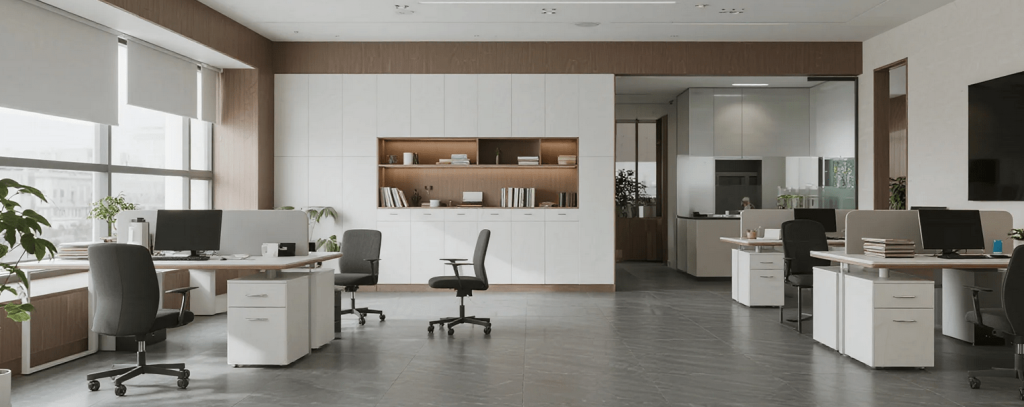
Introduction
The workplace environment has a direct influence on how people communicate, collaborate, and complete daily tasks. In Feng Shui, office layout is understood as the organization of space to support function, movement, and human interaction.
Unlike residential Feng Shui, which focuses on rest, privacy, and personal comfort, office Feng Shui addresses a different purpose:
Creating an environment that supports professional activity and effective workflow.
This article focuses specifically on office layout principles. Topics such as executive desk placement, business growth symbolism, retail environments, and commercial buildings are covered separately in other Business Feng Shui articles.
The Role of Office Layout in Feng Shui
An office layout determines:
- How people move through the workplace
- How teams interact
- How different functions are separated
- How employees experience their working environment
From a Feng Shui perspective, the arrangement of space influences the relationship between people and their surroundings.
Principle 1: Clear Functional Zones
A balanced office should have clear areas for different activities.
Common workplace zones include:
- Individual work areas
- Collaboration spaces
- Meeting areas
- Reception areas
- Rest areas
Clear separation helps employees understand how each part of the office is intended to function.
Principle 2: Support Natural Movement
Office circulation affects both efficiency and comfort.
A practical Feng Shui office layout considers:
- Easy movement between areas
- Accessible shared resources
- Avoiding unnecessary obstacles
- Logical connection between departments
The goal is not simply open space, but efficient movement.
Principle 3: Balance Between Collaboration and Focus
Modern offices require both teamwork and concentration.
A well-planned layout balances:
Collaborative Spaces
Designed for:
- Communication
- Meetings
- Team activities
Focus Spaces
Designed for:
- Concentration
- Individual tasks
- Deep work
Feng Shui office planning emphasizes creating appropriate environments for different types of work.
Principle 4: Relationship Between People and Space
Office Feng Shui focuses strongly on human experience.
Important considerations include:
- Whether employees feel comfortable in their workspace
- Whether communication is supported
- Whether the environment feels organized
- Whether people can perform tasks effectively
The workplace is viewed as an interaction between humans and their surroundings.
Principle 5: The Importance of Entry and Reception Areas
The entrance area of an office creates the first internal experience for:
- Employees
- Clients
- Visitors
A functional reception area helps establish:
- Clear direction
- Professional organization
- Comfortable arrival experience
This topic differs from residential entryway Feng Shui because the purpose is professional interaction rather than private living.
Principle 6: Workplace Order and Organization
A well-organized office environment supports daily operations.
This includes:
- Clear storage systems
- Reduced unnecessary clutter
- Accessible working materials
- Defined work areas
Organization is one of the most practical connections between traditional Feng Shui ideas and modern workplace design.
Office Layout in Different Workplace Types
Corporate Offices
Larger organizations require clear separation between departments, meeting areas, and individual work zones.
Small Offices
Smaller workplaces often need flexible layouts that maximize limited space.
Creative Workspaces
Creative environments may require more adaptable areas for collaboration and idea exchange.
Common Misunderstandings
Office Feng Shui Is Not About Wealth Objects
Popular content often focuses on lucky items or symbols.
However, office Feng Shui is primarily concerned with how workplace environments function.
A Good Layout Does Not Guarantee Business Success
Feng Shui should not be presented as a guaranteed method for financial results.
A well-designed workplace can support comfort, organization, and productivity, but business outcomes depend on many factors.
Open Offices Are Not Automatically Better
Open layouts may improve communication but can also create challenges related to concentration and privacy.
The best design depends on the specific workplace needs.
Modern Perspective
Modern workplace design shares many ideas with Feng Shui office principles.
Contemporary offices consider:
- Ergonomics
- Employee experience
- Workflow efficiency
- Acoustic planning
- Flexible workspaces
These approaches recognize that physical environments influence how people interact and work.
Frequently Asked Questions
What is Feng Shui office layout?
It refers to organizing workplace spaces according to principles of function, movement, balance, and human interaction.
Does Feng Shui improve office productivity?
A well-designed workplace may support comfort and efficiency, but productivity depends on many factors beyond physical space.
Is desk placement part of office layout?
Yes, but detailed desk positioning belongs to specific command position applications rather than this general office layout guide.
Can Feng Shui apply to modern offices?
Yes. Traditional concepts can be adapted to contemporary workplaces by focusing on spatial organization and human experience.
Classical & Historical Sources
Classical Chinese Texts
- The Book of Changes (易经 / I Ching)
Provides philosophical foundations for understanding balance, relationships, and dynamic systems. - The Book of Burial (葬书 / Zang Shu)
Developed ideas about environmental relationships and spatial harmony that influenced later Feng Shui applications.
Historical Context
Traditional Feng Shui was originally developed primarily around residential and landscape environments. As commercial spaces evolved, practitioners adapted Feng Shui concepts to workplaces, shops, and public buildings.
Modern Perspective
Today, office design is influenced by architecture, organizational psychology, ergonomics, and workplace research. Feng Shui offers a cultural framework that emphasizes the relationship between people and their working environment.
Related Guides
Continue exploring Business & Office Feng Shui:
- Business & Office Feng Shui(pillar)
- Retail Feng Shui Design
- Commercial Property Feng Shui
- Feng Shui Restaurant
- Feng Shui for Property Value
- Feng Shui Modern
- Feng Shui for Small Business
- Feng Shui for Home Office
Conclusion
Feng Shui office layout is best understood as the organization of workplace space to support function, communication, and human interaction.
Rather than focusing on symbolic objects or guaranteed outcomes, a practical Feng Shui approach examines how people move, collaborate, and experience their working environment.
By creating clearer zones, smoother circulation, and more functional workplace structures, businesses can develop environments that better support everyday professional activities.
View the Business&Office Feng Shui navigation page.
This content is based on traditional cultural and folk interpretations and is provided for informational purposes only.
Published by Mystical East — Your gateway to authentic Chinese metaphysics for a modern world.